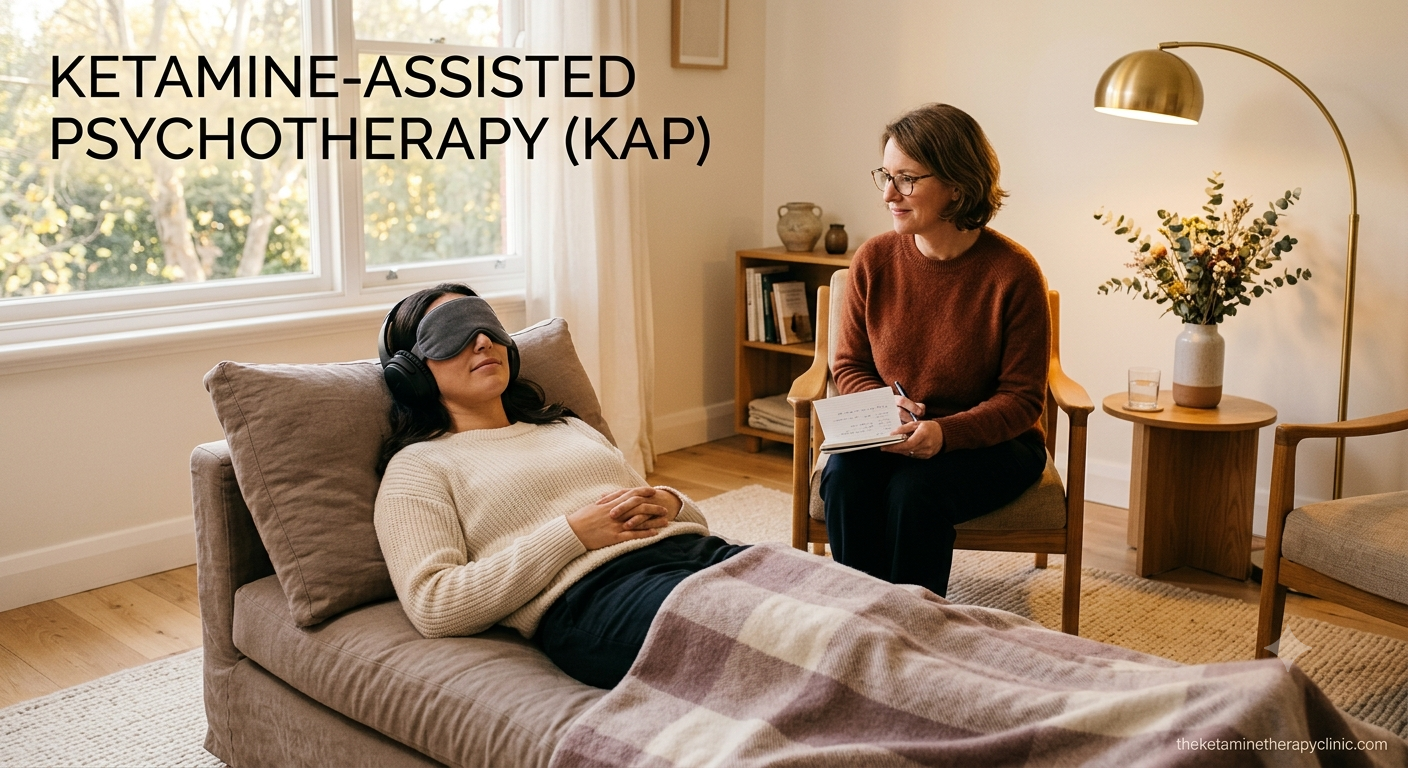
If you’ve been researching ketamine therapy in Washington, D.C., Maryland, or Virginia, you’ve probably come across two very different-sounding paths: a straightforward ketamine infusion, and something called Ketamine-Assisted Psychotherapy, or KAP. They both use the same medicine. They are not the same treatment. Understanding the difference matters, because which one fits you depends less on your diagnosis and more on what kind of healing process you’re looking for.
What Is Ketamine-Assisted Psychotherapy?
Ketamine-Assisted Psychotherapy pairs a dose of ketamine with structured, in-session psychotherapy — rather than administering the medication on its own and sending you home once your vitals are stable. The idea is that ketamine’s effects (a temporary loosening of rigid thought patterns, reduced emotional defensiveness, and an altered state of awareness) create a window in which trauma, grief, and deeply rooted patterns become easier to approach in therapy than they are in an ordinary talk-therapy session.
Where a standard infusion treats ketamine purely as a fast-acting antidepressant, KAP treats the ketamine experience itself as clinically useful material, something to be prepared for beforehand and actively worked through with a therapist, both during the session and in the weeks after.
How KAP Differs from Standard Ketamine Infusion Therapy
The medicine can be identical. The structure around it is not.
Role of the clinician. In a standard infusion, a nurse or provider primarily monitors vital signs. In KAP, a licensed therapist is present for some or all of the dosing session and plays an active role before, during, and after.
Purpose of the session. Infusion therapy is designed to produce a neurochemical shift. KAP uses that same shift as an entry point for psychological work, processing memories, reframing beliefs, or approaching trauma that talk therapy alone hasn’t been able to reach.
Setting. Infusions typically happen in a clinical treatment room with a recliner and monitoring equipment. KAP sessions are often held in a calmer, therapy-oriented space, with lower lighting, music, and minimal clinical interruption, though medical safety monitoring is still part of the protocol.
What happens afterward. Standard infusion patients usually go home once cleared. KAP includes a dedicated integration step — a follow-up therapy session focused specifically on making sense of what came up and translating it into lasting change.
Neither approach is universally “better.” They’re built for different goals, and your provider should help you decide which structure actually serves what you’re trying to work through.
The Three Phases of Ketamine-Assisted Psychotherapy (KAP)
Most Ketamine-Assisted Psychotherapy programs are organized around three distinct phases:
1. Preparation
Before any medication is given, you meet with your therapist to talk through your history, your intentions for treatment, and what to expect from the ketamine experience itself. This phase builds the trust and framework that make the dosing session productive rather than just intense.
2. Dosing
You receive ketamine (typically via intramuscular injection, oral lozenge, or occasionally IV Ketamine Therapy, depending on your provider’s protocol) while your therapist is present. Some clinicians engage in guided conversation during this window; others allow the patient to move inward and process silently, checking in afterward. Medical staff monitor safety throughout.
3. Integration
In the days following the session, you meet again with your therapist to unpack what surfaced — emotions, memories, or insights and connect it back to your everyday life and ongoing treatment goals. Clinicians and researchers generally consider integration the phase that determines whether the benefits of a KAP session actually last.
Who KAP Tends to Be a Good Fit For
KAP is most often considered for patients who:
- Have treatment-resistant depression that hasn’t responded fully to medication or standard talk therapy
- Are working through PTSD or trauma that feels difficult to access verbally
- Experience anxiety or emotional avoidance patterns that keep talk therapy at a surface level
- Are already in therapy and want to use ketamine to deepen that existing work, rather than replace it
KAP is not necessarily a better starting point than Ketamine infusion therapy for every patient — someone looking primarily for rapid symptom relief with less emphasis on in-session processing may do just as well with a standard infusion protocol. A consultation is the most reliable way to figure out which structure matches your goals.
What to Expect at a Washington DC – Area KAP Session
Ketamine therapy in Washington DC, Maryland, and Virginia area generally structure KAP around an initial psychiatric evaluation, one or more preparation sessions with a therapist, the dosing session itself (often 90 minutes to two hours, including monitoring time), and at least one integration session afterward. The full arc — from intake to integration — is usually longer than a single infusion appointment, since the therapeutic relationship is central to how the treatment works, not incidental to it.
Is Ketamine-Assisted Psychotherapy (KAP) Right for You?
The honest answer is that it depends on what you’re trying to resolve, how you respond to structured therapy, and what your provider’s clinical judgment recommends after an evaluation. If you’re weighing KAP against a standard ketamine infusion — or want to know whether your situation is a better match for one approach over the other — the clearest next step is a consultation with a provider who offers both, so the recommendation is based on your history rather than a generic protocol.
Frequently Asked Questions
Is Ketamine-Assisted Psychotherapy the same as ketamine infusion therapy?
No. Both use ketamine, but KAP integrates a licensed therapist and structured psychotherapy into the preparation, dosing, and follow-up process, while standard infusion therapy focuses on medical administration and monitoring.
Do I need to already be in therapy to start KAP?
Not necessarily, though many KAP programs will connect you with a therapist as part of the treatment structure if you don’t already have one. Some patients also choose to continue with their existing therapist alongside the KAP protocol.
Is Ketamine-Assisted Psychotherapy covered by insurance?
Coverage varies by provider, plan, and whether the psychotherapy and medical components are billed separately. Many patients use HSA or FSA funds toward out-of-pocket costs. It’s worth confirming your specific benefits directly with your provider’s office before starting treatment.
How many KAP sessions does it typically take to see results?
This varies by individual and by what’s being treated. Many programs start with an initial series of sessions and then reassess, since response to both the ketamine and the therapeutic process differs from patient to patient.
~This article is for educational purposes and is not a substitute for a medical or psychiatric evaluation. If you’re considering Ketamine-Assisted Psychotherapy, schedule a consultation to discuss whether it’s an appropriate fit for your history and treatment goals.